


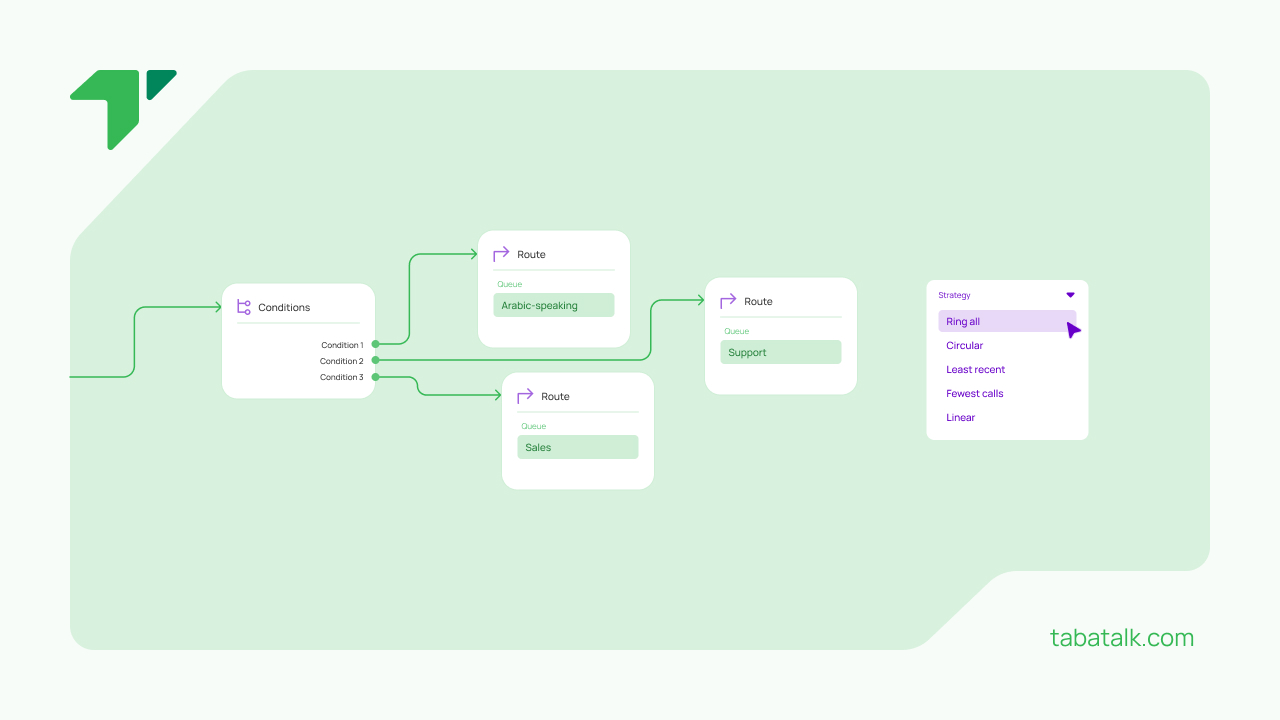
That’s where Automatic Call Distribution (ACD) comes in.
According to Grand View Research, the global contact center software market is expected to reach $173.9 billion by 2030, driven largely by the adoption of cloud-based ACD and AI routing systems. The reason is simple: ACD ensures every inbound call gets where it needs to go—fast, intelligently, and consistently.
This guide unpacks everything you need to know about ACD: what it is, how it works, the different routing methods available, and why it matters for modern contact centers. You’ll also see real-world examples of how TabaTalk’s AI-driven ACD helps BPOs, fintechs, and global CX teams turn call routing into a revenue driver.
ACD vs IVR: What’s the Difference?
ACD and IVR are often confused, but they serve very different roles.
- ACD is the distribution engine. It decides which agent or queue should handle an inbound call based on rules, skills, or AI models.
- IVR (Interactive Voice Response) is the navigation system. It lets customers press or speak options to help ACD determine where to send them.
Think of IVR as the receptionist asking “What brings you here today?” and ACD as the air traffic controller making sure the customer lands in the right place.
Both systems work best together. The IVR gathers intent data, while ACD executes routing decisions. Without IVR, ACD might lack context. Without ACD, IVR becomes a dead-end.
How ACD Supports the Contact Center Ecosystem
ACD isn’t just another feature—it’s the orchestration layer that holds the contact center together.
- It bridges telephony and CRM by connecting caller data from Salesforce, Zoho, or other systems to the routing logic.
- It drives operational KPIs like First Call Resolution (FCR), Average Handle Time (AHT), and queue abandonment.
- It balances agent workloads, preventing idle time and burnout.
- It supports compliance and global operations, adapting routing to time zones, languages, or PCI/GDPR rules.
With tools like TabaTalk’s Flow Builder, this logic becomes easy to configure in a visual, drag-and-drop environment—removing the complexity that historically required coding or IT support.
How ACD Works (Step-by-Step)
Although the underlying technology can be complex, ACD follows a logical sequence. Here’s the process broken down into simple stages:
Caller Identification & IVR Pre-Sorting
The first step is recognizing who the caller is and why they’re calling. ACD systems pull data from several sources:
- ANI (Automatic Number Identification) for phone numbers
- IVR input from keypress or speech recognition
- CRM tags from Salesforce, Zoho, or Freshdesk integrations
This information is used to profile the caller. For example, a bank’s ACD might flag a call from a high-value VIP client and prioritize routing accordingly.
Call Queueing Logic & Prioritization
Next, ACD places calls into queues. Not all queues are created equal:
- FIFO (First-In, First-Out) treats all callers equally.
- Priority queuing pushes VIPs, compliance cases, or urgent issues ahead.
- SLA-based queuing factors in promised service levels to reorder calls.
The system assigns wait times and positions dynamically. Imagine a hospital where emergency triage calls skip the line while general inquiries wait in FIFO order—that’s ACD logic in action.
Routing Algorithms Explained
Once calls are queued, ACD selects the right agent using routing algorithms:
- Round-robin: Calls cycle evenly across agents.
- Fixed routing: Calls always go to the same agent or team.
- Simultaneous ringing: All agents’ phones ring until one answers.
- Skills-based routing: Calls are matched to agents with the right expertise.
- Predictive routing: AI analyzes patterns to assign the “next best agent.”
- Overflow routing: Calls spill into backup queues when thresholds are exceeded.
With [TabaTalk Flow Builder], admins can create these pathways in minutes using a visual editor—no coding required.
Types of ACD Call Routing
Different routing methods work better in different scenarios. Here’s how they compare.
Round-Robin, Fixed, and Simultaneous
- Round-robin ensures fairness and avoids overloading one agent. Best for small support teams.
- Fixed routing works for specialized accounts where consistency is key. Common in dedicated BPO setups.
- Simultaneous ringing guarantees urgent calls are answered as fast as possible. Useful for hotlines.
Skills-Based & Weighted Distribution
Skills-based routing tags agents by product expertise, certifications, or language. Weighted distribution adds precision: if one agent is faster or more experienced, they can take a higher share (e.g., 70/30 split).
This method boosts FCR by ensuring customers reach someone who can solve their problem immediately. It’s particularly powerful in technical support centers or multilingual environments.
Time-, Language-, and Geography-Based Routing
ACD adapts to the realities of global operations:
- Time-based routing respects working hours across regions.
- Language-based routing directs callers to agents fluent in their language.
- Geography-based routing ensures compliance with regional regulations.
For fintechs and multinational retailers, multilingual routing is essential for customer trust.
AI-Based & Predictive Routing
The cutting edge of ACD is predictive, AI-driven distribution.
TabaTalk’s AI ACD combines intent prediction with Answering Machine Detection (AMD) to maximize efficiency. For outbound campaigns, AMD filters out voicemail answers, while predictive algorithms route live calls to the best agent in real time. The result is more talk time, fewer wasted minutes, and higher ROI.
Benefits of ACD for Modern Contact Centers
The “why” behind ACD is just as important as the “how.” Done right, it transforms both customer and agent experience.
Higher First-Call Resolution (FCR)
By routing customers to the right agent the first time, ACD dramatically improves FCR. Industry studies show that raising FCR by just 10% can boost customer satisfaction by 20% and reduce operating costs by 12%.
Lower Average Handle Time (AHT) & Reduced Burnout
Smart routing doesn’t just shorten calls; it sets agents up for success. When agents consistently get cases they’re trained for, calls resolve faster and stress is lower. That means lower AHT without sacrificing quality—and happier agents who stick around longer.
Reduced Wait Times & Abandonment Rates
Queue management features like callbacks, priority queuing, and overflow routing directly reduce wait times. Lower waits lead to fewer abandoned calls, a critical metric in revenue-focused contact centers.
Imagine reducing a five-minute average queue to under two minutes. That’s not just a CX win—it’s a direct cost saving.
Smart Workload Balancing = Happier Agents
ACD acts like air traffic control for agent workloads, distributing calls evenly and dynamically. No more idle time for some while others are overwhelmed. Balanced workloads reduce burnout and increase productivity.
Real-World Example: How TabaTalk’s ACD Delivers Results
BPO Use Case: 3.5x Talk Time Increase
A global BPO deployed TabaTalk’s AI ACD with Answering Machine Detection to optimize outbound campaigns. By filtering out 78% of machine-answered calls, agents spent 3.5 times more minutes talking to live customers. That translated into higher conversions and lower operational costs per sale.
Fintech Use Case: Multilingual Routing with VIP Prioritization
A fintech company serving international clients needed smarter routing. By integrating CRM tags into TabaTalk ACD, VIP customers were identified instantly and prioritized. At the same time, multilingual routing ensured Spanish, French, and Mandarin speakers reached fluent agents without delays.
The result: faster handling of high-value accounts, improved compliance scores, and stronger retention rates.
Key Features to Look For in ACD Systems
Not all ACD platforms are created equal. When evaluating options, look for these must-haves:
CRM + CTI + WFM Integrations
Your ACD should integrate seamlessly with CRM systems like Salesforce or Zoho, CTI solutions, and workforce management tools. This ensures data continuity and accurate reporting. TabaTalk’s plug-and-play integrations make this painless.
Omnichannel Support (Voice, SMS, Chat)
ACD should not be voice-only. Modern platforms distribute across SMS, chat, and digital channels. TabaTalk’s Flow Builder allows orchestration across all these channels, even deflecting IVR calls to WhatsApp or SMS for faster resolution.
Real-Time Analytics + Agent Coaching Tools
Visibility is key. Look for real-time dashboards that show routing performance and queue health. Pair this with call coaching tools—like whisper, barge-in, and speech analytics—for continuous improvement.
Auto-Attendants, Overflow, Callbacks, and Recording
Essential ACD systems include auto-attendants, overflow routing, callback scheduling, and call recording. These features prevent call drops and ensure every customer finds a resolution path.
Implementation Challenges (And How to Solve Them)
Even the best ACD systems come with hurdles. Here’s how to handle them.
Training & Agent Adoption
Agents need time to adjust to new routing logic. Offer sandbox training environments where they can see routes in action before going live.
System Compatibility & Data Hygiene
Legacy systems and messy CRM data can undermine routing accuracy. Using TabaTalk’s CRM sync features ensures customer data stays clean and usable.
Common ACD Errors and Fail-Safes
Misconfigured routes, infinite loops, and unclear overflow rules can create chaos. TabaTalk’s automatic flow troubleshooting catches these errors before they impact customers.
ACD in 2025: What’s Next?
Routing technology is evolving quickly. Here’s what to expect.
AI, Language Models, and Proactive Routing
ACD will move from reactive to proactive. Large language models will pre-classify calls, predict intent, and assign agents before the call is even answered.
Localization, Personalization, and Trust
Trust depends on personalization. Future-ready ACD will route based not just on skills, but on customer preferences, regions, and compliance requirements. TabaTalk already supports multilingual, location-based routing, positioning teams for this shift.
Frequently Asked Questions (FAQ)
What is ACD in contact centers?
Automatic Call Distribution is a system that routes incoming calls to the right agent or queue based on rules, skills, or AI algorithms.
How does ACD improve customer experience?
It increases first-call resolution, reduces wait times, and ensures customers reach the best-fit agent quickly.
Can ACD work with remote or international teams?
Yes. Cloud-based ACD like TabaTalk’s is location-agnostic, supporting distributed and hybrid teams across time zones.
What’s the ROI of implementing ACD?
ROI depends on scale, but savings are significant. For example, every $1 spent on AMD filtering in outbound campaigns can yield up to $10 in recovered agent productivity.
The Bottom Line
Automatic Call Distribution is the heart of modern contact centers. It doesn’t just route calls—it drives KPIs, shapes customer experience, and protects agent wellbeing.
With features like AI-powered predictive routing, multilingual support, and deep CRM integrations, ACD turns routing into a competitive advantage. And with solutions like TabaTalk’s ACD, contact centers gain the intelligence and flexibility they need to scale efficiently, deliver consistently, and grow revenue.